
%20--%3e%3csvg%20version='1.1'%20id='Layer_1'%20xmlns='http://www.w3.org/2000/svg'%20xmlns:xlink='http://www.w3.org/1999/xlink'%20x='0px'%20y='0px'%20viewBox='0%200%2030%2029'%20style='enable-background:new%200%200%2030%2029;'%20xml:space='preserve'%3e%3cstyle%20type='text/css'%3e%20.st0{fill-rule:evenodd;clip-rule:evenodd;fill:%23FFFFFF;}%20%3c/style%3e%3cg%20id='Symbols'%3e%3cg%20id='Footer'%20transform='translate(-468.000000,%20-360.000000)'%3e%3cg%20id='Group-5-Copy'%20transform='translate(468.000000,%20360.000000)'%3e%3cpath%20id='Fill-1'%20class='st0'%20d='M17.1,26.8h9.3c0.2,0,0.4-0.2,0.4-0.4V2.6c0-0.2-0.2-0.4-0.4-0.4H2.6c-0.2,0-0.4,0.2-0.4,0.4%20v23.8c0,0.2,0.2,0.4,0.4,0.4h12.3v-8.2h-3.3c-0.6,0-1.1-0.5-1.1-1.1s0.5-1.1,1.1-1.1h3.3v-4.8c0-2.3,1.8-4.1,4.1-4.1h3%20c0.6,0,1.1,0.5,1.1,1.1S22.6,9.7,22,9.7h-3c-1,0-1.9,0.8-1.9,1.9v4.8h3.3c0.6,0,1.1,0.5,1.1,1.1s-0.5,1.1-1.1,1.1h-3.3V26.8z%20M26.4,29H2.6C1.2,29,0,27.8,0,26.4V2.6C0,1.2,1.2,0,2.6,0h23.8C27.9,0,29,1.2,29,2.6v23.8C29,27.8,27.9,29,26.4,29L26.4,29z'/%3e%3c/g%3e%3c/g%3e%3c/g%3e%3c/svg%3e)

%20--%3e%3csvg%20version='1.1'%20id='Layer_1'%20xmlns='http://www.w3.org/2000/svg'%20xmlns:xlink='http://www.w3.org/1999/xlink'%20x='0px'%20y='0px'%20viewBox='0%200%2030%2030'%20style='enable-background:new%200%200%2030%2030;'%20xml:space='preserve'%3e%3cstyle%20type='text/css'%3e%20.st0{fill:none;stroke:%23FFFFFF;stroke-width:2;stroke-linecap:round;stroke-linejoin:round;}%20.st1{fill:none;stroke:%23FFFFFF;stroke-width:2.6;stroke-linecap:round;stroke-linejoin:round;}%20%3c/style%3e%3cg%20id='Symbols'%3e%3cg%20id='Footer'%20transform='translate(-568.000000,%20-360.000000)'%3e%3cg%20id='Group'%20transform='translate(569.000000,%20361.000000)'%3e%3cpath%20id='primary'%20class='st0'%20d='M20,22v-4.8c0-1.8-1.3-3.2-3-3.2l0,0c-1.7,0-3,1.4-3,3.2V22'/%3e%3cpath%20id='primary-2'%20class='st0'%20d='M26.4,28H1.6C0.7,28,0,27.3,0,26.4V1.6C0,0.7,0.7,0,1.6,0h24.9C27.3,0,28,0.7,28,1.6v24.9%20C28,27.3,27.3,28,26.4,28z%20M7.8,14v7.8%20M14,17.1V14'/%3e%3cline%20id='primary-upstroke'%20class='st1'%20x1='7.8'%20y1='8.5'%20x2='7.8'%20y2='8.1'/%3e%3c/g%3e%3c/g%3e%3c/g%3e%3c/svg%3e)
As energy prices rise and electricity demand surges, households across the country are facing higher utility bills.
Solar and battery storage is the grid-stabilizing solution that lowers electricity costs for ratepayers and reduces our reliance on volatile fossil fuel markets. Solar and storage generates low-cost power, stores it when it’s abundant, and delivers it when it’s most needed. Unlike fossil fuels, which are subject to significant price volatility, solar and storage leverages free and abundant energy from the sun, cutting peak demand costs and providing a long-term energy affordability solution while strengthening local grids.
What Is Solar and Battery Storage?
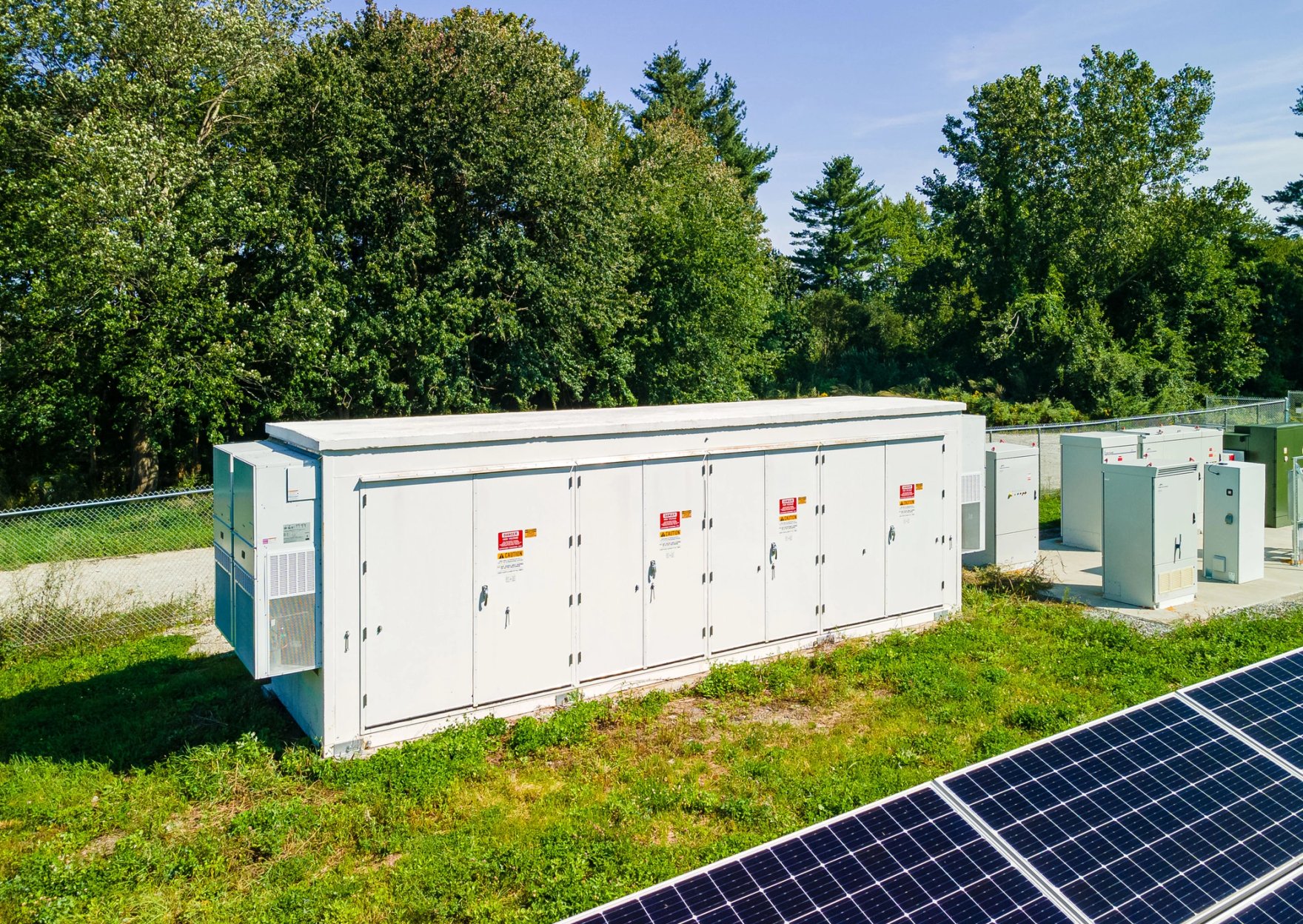
Solar and battery storage combines two impactful technologies: solar panels, which generate electricity during the day, and battery energy storage systems, which store excess electricity for later use.
Batteries store excess cheap energy and send it to the grid when demand and prices are higher. Battery storage is a reliability tool, allowing clean, low-cost solar energy to be used at the time when energy demand is the highest.
How Solar and Battery Storage Lowers Electric Bills
Solar Is the Lowest-Cost Energy Source
Solar power is now one of the cheapest forms of new electricity generation globally. Over the past decade, the cost of solar electricity has dropped dramatically — nearly 80% since 2010.
Unlike fossil fuels, there is no fuel cost associated with solar. Once the panels are installed, the energy source, sunlight, is abundant and free. This stability shields customers from the swings in natural gas and other fossil fuel prices that contribute to higher electricity bills.
Batteries Reduce Peak Electricity Costs
Electricity is most expensive during peak demand periods. These are times when there is significant electricity demand and therefore greater strain on the grid, for example during hot summer afternoons or cold winter evenings.
Battery storage systems are a game changer for cost-effective and stable energy during times like these. Battery storage is capable of:
- Storing electricity that is generated when prices are low
- Sending energy to the grid when prices spike
- Reducing the need for expensive “peaker” plants
- Lowering wholesale electricity prices
Solar and battery storage reduce peak demand costs for all ratepayers, not just solar adopters, because it allows the electricity system to avoid having to dispatch the highest cost generators out there.
In fact, recent independent analysis shows that expanding distributed solar paired with storage can deliver significant annual savings, as much $1bn annually by 2035 in New York State.
Solar and Storage Reduce Reliance on Volatile Gas Markets
Despite its inherent price volatility, natural gas remains a major fuel source for electricity generation in the United States. When gas prices rise, electricity prices follow, putting more financial stress on ratepayers. These shifts make ratepayers constantly vulnerable to major changes in their energy costs. Solar and storage has proven itself to be the most effective option for leveling out rising electric bills. Scaling solar and storage will help protect customers from fuel price spikes, supporting long-term energy affordability.
Why Solar and Storage Is Critical Right Now
Electricity Demand Is Growing Rapidly
The electrification of vehicles and buildings, combined with AI and data center growth, is driving unprecedented demand for electricity. We’re seeing demand climb significantly for the first time in decades.
Traditional fossil infrastructure takes years to build, and gas turbine supply chains are constrained through the end of the decade.
Solar and storage can deliver new capacity in months rather than years. The speed of solar and storage solutions is one of several valuable qualities of the technology.
Battery Storage Is Now Cost-Competitive
Battery costs in the U.S. have fallen significantly in recent years. In many markets, the cost of scaling battery storage is competitive, if not cheaper than new gas peaker plants for meeting peak demand. As a bonus, storage comes without emissions or fuel price risk,
Additionally, a 30% federal investment tax credit for standalone energy storage remains available through 2033, lowering deployment costs and accelerating savings for ratepayers.
The economics behind storage are strong.
Solar and Battery Storage Improves Grid Reliability
Energy affordability and grid reliability are increasingly connected.
Outages driven by extreme weather events are becoming more common, as these extreme weather events become more common. Our aging grid infrastructure is under stress. Solar and battery storage helps stabilize the system by:
- Smoothing supply and demand spikes
- Providing backup power during outages
- Reducing strain on transmission systems
Research shows that a majority of U.S. households could reduce electricity costs with solar-battery systems under current market conditions. Solar and storage would also provide these households with meaningful backup power for essential needs during outages. This reaffirms solar and storage’s position as a reliability solution, reducing risk of outages and lowering grid strain.
Distributed Solar and Storage: Benefits for Everyone
Distributed solar, installed on rooftops, parking canopies, brownfields, and community solar sites, generates power closer to where it’s consumed.
This reduces:
- Transmission congestion
- Infrastructure upgrade costs
- Energy losses
- System-wide peak demand
When paired with battery storage, distributed solar becomes even more powerful by delivering electricity exactly when it’s most needed.
Importantly, large-scale expansion of distributed solar + storage has been shown to reduce overall energy system costs, benefiting all customers, even those who don’t directly install solar.
That’s the big picture: affordability at scale.
FAQs about solar and battery storage
The Bottom Line: Energy Affordability Requires Modern Infrastructure
If we’re serious about solving the energy affordability crisis, we need solutions that are:
- Fast to deploy
- Cost-competitive
- Scalable
- Reliable
- Clean
Solar and battery storage meets all five criteria.
At Nexamp, we believe clean energy should work for everyone — delivering real savings, strengthening grid reliability, and building resilient communities.
The technology is proven. The economics are compelling. The urgency is clear.
The question isn’t whether solar and battery storage can lower energy costs.
It’s how quickly we choose to scale it.